Tuesday, February 06, 2007

US TOUR 2007, DAY TWENTY-ONE:

It was the best of days and the worst of days.

Tipping out of a hotel room at midday, we made our way - via a quick lunch in a Greek restaurant - to the studios of Capital Public Radio in Sacramento to be interviewed live for the "Insight" programme hosted by Scots exile Jeffrey Callison.

Sitting in the green room, nervously clutching the extract from "Extraordinary People" that I was to read during the interview, I got distracted listening to the guest ahead of me. Her name was Kim Phuc. You might never have heard of her, but you've almost certainly seen her. She was the little girl on fire in the photograph taken during the Vietnam war following a napalm attack. She was running down the road towards the camera, arms raised, trying to escape the fire and the pain.

Miraculously she survived, but only because the man who took the photograph, Nick Ut, got her to a hospital. She had burns across nearly two thirds of her body, had something like seventeen operations, and was in hospital for a year-and-a-half. She was nine years old when it happened. The photographer now lives in Los Angeles, and they still keep in touch, talking by phone at least once a week.

When the Vietnamese government discovered some years later that the girl in the photograph was still alive, they attempted to exploit her for propaganda purposes, interrupting her medical studies at home to send her to Cuba to train in languages. There, she met her future husband - also a Vietnamese. They were told that they had to honeymoon in Moscow, but when the plane stopped to refuel in Canada, they took their chance to seek political asylum.

She has lived there, ever since, raising children, and only recently taking them back to Vietnam to visit the spot where she was pictured in flames.

As I sat listening, she recounted the story of her meeting with the man who had coordinated that napalm bombing mission in 1972. He asked if she could ever forgive him, and without hesitation she told him she had already done so.

She now runs an organisation that works to help children who are the victims of war.

There was something extraordinarily moving in her simple articulatation of the dreadful pain she suffered, and the difficult journey of her life from that moment to this. Her courage and suffering reduced my nerves at speaking on live radio to something considerably less than inconsequential.

So it was without fear that I read my piece and did my interview, reducing Jeffrey to open-mouthed amazement at the story of my pathology adviser, Dr. Steve Campman, and the French woman whose life he saved - all because of a scene I had written in "The Firemaker".

Off then, to a wine bar in downtown Sacramento called 58 degrees to discuss the promotion next year of the follow-up book to "Extraordinary People", which is set amongst the vineyards of southwest France. The book is already written, and plans for a uniquely different tour to promote it are fermenting nicely. And just to keep our discussions well lubricated we had a glass or three of excellent wine to wash down the words.

The book event at the Avid Reader in Davis that night was seriously quiet. The town was deserted. Monday evening, the day after the Super Bowl... maybe not the best time for a talk on mystery books set in France and China.

So we turned it into a drop-in signing, and I signed all the copies of "Extraordinary People", "The Fourth Sacrifice" and "The Firemaker" that the store had got in stock for the event. A signed book is a sold book, so all in all, we did not too badly.

And, you know, each time I think of that little girl, arms outstretched, running down the road, it puts all my troubles, whatever they might be, into their proper perspective.

(Copyright, Nick Ut/Associated Press)

Monday, February 05, 2007

US TOUR 2007, DAY TWENTY:

Just a boring old travel day. Actually, a really quiet travel day. Because this is the day when America comes to a full stop.

IT'S SUPERBOWL!!

Yes, the day that Janet Jackson bared a nipple for all of half a second and shocked a nation. Well, having taken elaborate safeguards to ensure that nothing so obscene should ever be seen again in this country that hosts the world's biggest porn industry, Americans were settling down again to watch a game between a team from Chicago (the Bears), and a team from (I think) Indianapolis. Why anyone else in the country would give a damn who wins beats me.

In an FA Cup final between, say, Leicester and Coventry, no one outside of those two sets of supporters (except for a few diehard soccer fans) would even bother to watch the game.

It is a phenomenon unique to the US. Some poor fellow authors at Left Coast Crime were scheduled to sign books at the Seattle Mystery Bookshop this afternoon. By kick-off time, it was expected that the town would be deserted and that beyond that time no one would turn up at the store. I'm glad I did my signing yesterday, when the store was jam-packed.

Even on the ride out to the airport it was apparent that the streets were emptying. The airport itself was a bit like a ghost town, and the few people sitting at gates waiting for their flights were all glued to TV sets showing the game.

With four hours to wait, I'm actually sitting here writing this to kill the time.

In a few hours I will meet up again with La Patronne and Susie at Sacramento and the tour will begin in earnest - an hour-long interview on Sacramento public radio tomorrow afternoon, followed by a talk and signing at the Avid Reader bookstore in Davis. Then on Tuesday it's San Mateo, and on Wednesday San Francisco. And so on...

From a nearby TV the cheers of the crowd are ringing in my ears.

As a famous American poet once wrote: The woods are lovely, dark and deep, but I have promises to keep. And miles to go before I sleep!


A couple of Seattle streets buskers (no, NOT Bill and Tanya!)...

PS: For those following the blog, it wasn't Bill at the Seattle Opera.

Sunday, February 04, 2007

US TOUR 2007, DAY NINETEEN:

Thirty years ago I was best man at the wedding of Bill and Tanya Hill at Martha Street registry office in Glasgow.

It is more than twenty years since I last set eyes on them.

This morning we met again, the three of us, in a hotel lobby in Seattle, and it was as if all the years in between had never been. We went upstairs to the cafe and shared brunch. We talked for three hours, built fragile bridges that spanned the time in between, and saw in one another the people we had once been - and still are.

But we have come such a long way, all of us, since those early days when Bill and I first met as cub reporters on a local daily newspaper in the provincial Scottish town of Paisley. We moved on then to Scotland's top broadsheet, "The Scotsman", where we sat across a desk from one another for nearly five years.

But we shared so much more than a job. We spent many hours together writing and playing and recording music, talking, dreaming - knowing that the future must hold more than the present. But neither of us could have dreamt then where it would take us, and that all these years later we would be grinning at one another like idiots across a cafe table in the Pacific Northwest of the United States.

Bill's story is one of extraordinary achievement against the odds. Born and brought up in a working class housing project in the notorious east-end of Glasgow, his father died when he was just fourteen, and he took on the mantle of man of the house, and breadwinner.

But Bill wasn't just a hard worker. He was smart. Really smart. He sat an exam and won a scholarship to one of Glasgow's top private boys' schools, Alan Glen's, where he excelled academically. But he was also a rebel, and rejected the conventional academic route through university, finally to carve out a niche for himself as a journalist. But with his long hair and thick, bushy beard, and his restless talent, he pushed at the boundaries of accepted convention. Spotted once by a rival newspaper busking in Buchanan Street in Glasgow on a Saturday afternoon, he was hauled over the coals by the editor of "The Scotlsman" after a story appeared in the gossip column of a Sunday tabloid, suggesting that "Scotsman" reporters were paid so poorly they had to go busking to make ends meet.

Of such things are legends made.

I left newspapers in 1979 to pursue a career as a writer, and over the next few years we lost touch. On a return visit one day to "The Scotsman", I learned that Bill had left to join a software company in Edinburgh. Seismic shift! And it wasn't until about five years ago that I discovered that Bill had gone on to distinguish himself in the field, co-inventing ClearType - a revolutionary way of presenting type on computer screens.

Head-hunted by Microsoft here in Seattle, Bill went through a rigorous interview process - not dissimilar to the selection procedure employed by the Ecole Nationale d'Adminstration (ENA) in France. Offered a job and welcomed aboard a company that was shooting for the stars (and getting there), he found that while his IQ of nearly 160 had usually made him the brightest guy in any gathering, he was now - in his own words - the dumbest guy in the room.

Which is typically self-effacing and, of course, belies the fact that he went on to become one of the brightest stars in the Microsoft constellation - finding himself addressing audiences of 3000 people and sharing the stage with one of the world's richest and best-known men, Bill Gates. Wearing his kilt, naturally (Bill H, not Bill G).

Bill's new life was telegraphed to him in a dream, where he saw wolves appearing through a breach in thick clouds, beyond which he caught sight of a star-studded sky. Whereupon he, himself, turned into a wolf and found himself running with other wolves through the woods.

He now lives in those wild woods outside Seattle, absorbing the wisdom of native Americans learning how to track and follow the very wolves he had once joined in his dreams. His wife, Tanya, has reflected those dreams in a wonderfully evocative series of paintings, and Bill returned to his musical roots to write and record an album of songs that tell the story.

They have a house in Hawaii, right down on the beach. At nearly fifty-eight Bill is learning to surf. He faces life fearlessly following a stroke ten years ago that nearly robbed him of his life (it was a stroke that killed his father, aged 44). "It made me not afraid any more," he told me. "To face life, to express myself, to stand up in front of three thousand people... I'm glad now that it happened."

He grinned at me. "Sometimes I find it hard to believe I'm here in Seattle, living this life, that I've come this far, by this route.. wee Willie Hill fae Barlanark."

It was an emotional reunion. And when, finally, we parted, we hugged, and our lives went off again on their separate and very different ways. And I found it hard to believe, and almost as hard to accept, that we should meet so briefly after all this time, and might never meet again.

Isn't life strange?

*******************************************

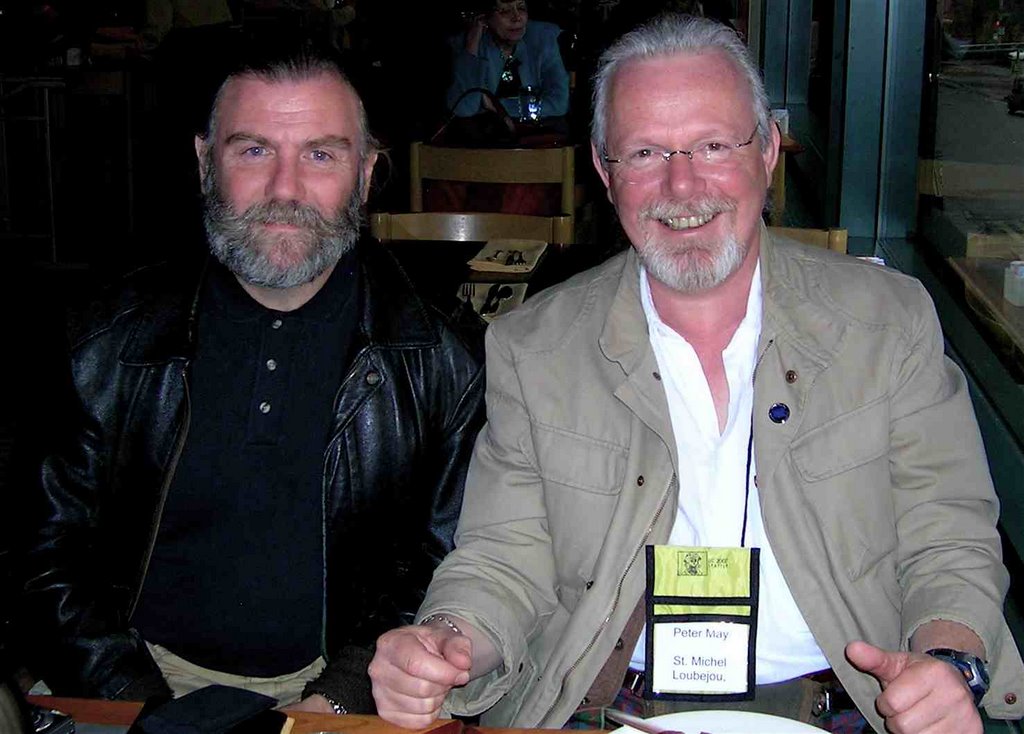
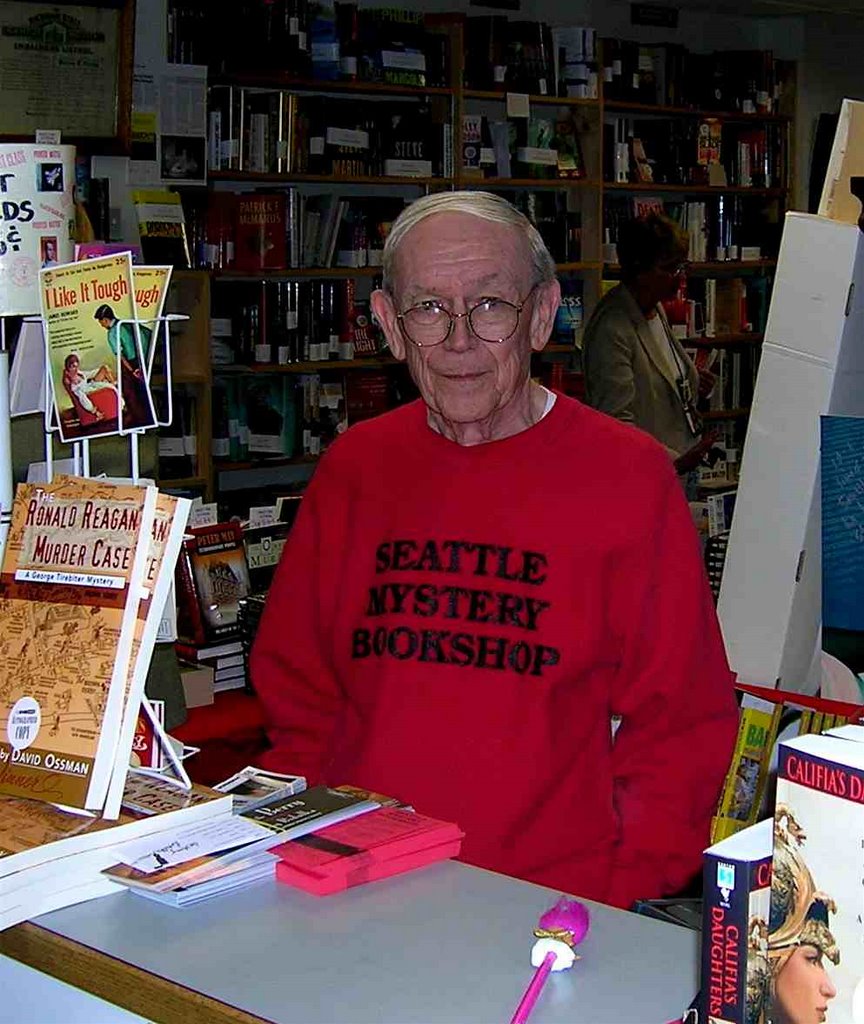
Following my reunion with the Hills I went to sign books for the good folk of the Seattle Mystery Bookshop, and had the privilege of meeting the store's founder, Bill Farley...

Saturday, February 03, 2007

US TOUR 2007, DAY EIGHTEEN:

This is one of these days where I have no idea where to begin.

Okay, so let's start with the people. Who did I meet? A half-Japanese female fan who had introduced me at Bouchercon in Chicago to Qiao Xialong.

She joined me in the lobby of the conference hotel while I was waiting to meet English author David Hewson. And what did she do? She introduced me to another two authors. It may be her gift.

Now, this is where it gets weird. The first writer lived in Hong Kong for several years, working as a financial journalist, before writing a book based on the white slave trade between Russian and Asia (a true story he had stumbled on as a journalist). Of course, he's an Eric. Eric Stone. A former radical activist turned capitalist who lives now in LA. And that book? "The Living Room of the Dead". One to read, I think.

And even weirder. A guy called Charles Benoit, a writer of books set in exotic locations with titles like "The Money Box" and "Veterans Day Memo". But that's not what's weird. What's really spooky is that he lives in Rochester, New York - where my brother-in-law (Le Beau Frere) lives. To be more accurate, Le Beau Frere lives in Fairport, where his children went to school, where his wife worked, and for whom he annually builds the sets for the school play.

And guess what? Charles Benoit's wife is a teacher at the same Fairport school!

Okay, so I never did make that rendezvous with David Hewson. I had a panel at 1pm and made my way to the Green Room to meet my fellow panellists. En route, I paused in the hallway to phone a lady called Kat Richardson to book a place at that night's special tour of "underground" Seattle (more of that later). I got her messaging service and left a message.

In the green room, I was gazing from the window when my cellphone rang. I answered it and a woman's voice asked, "Peter May?"

"Yes," I told her.

There was an odd hiatus, and then she said, "I'm standing right behind you." I turned around and there she was. She hung up the phone. "I'm Kat Richardson," she said. "I had no idea you were in the same room."

Anyway, I got my place booked for the night tour of underground Seattle.

Then there was the panel, which was extremely well moderated by Canadian writer Anthony Bidulka, who writes about gay detective, Russell Quant, bringing a whole new meaning to the term "private dick". My fellow panellists were Jon Talton from Phoenix (who shares both my US publishers and editors), Jo Dereske, who has written a very large number of books featuring her heroine Miss Zukas, and Pamela Samuels Young, a lady lawyer at Toyota who has created a highly successful fictitious lady lawyer called Vernetta Henderson.

We had about sixty people in the room, and a lively discourse that flew by. They should all be like that!

Then there was the St. Martin's Press cocktail party in a nearby hotel. We were invited by "Keith, Ruth and Andy". I have no idea who Keith and Andy are, and I didn't catch a single glimpse of Ruth - who is my editor. There was no one at the door to say "hi, what would you like to drink?" In fact, there was nobody I knew at all. So I sat in a corner, ordered a whisky, and sipped quietly watching newcomers arrive and stand around awkwardly wondering what they were doing there. Which would have been me if I hadn't found a seat and a drink. Last time I was at a St. Martin's party I got rescued by writer Carl Brookins. Sadly Carl wasn't there to do the honours this time.

I drank up and beat a hasty retreat to the official Left Coast Crime reception where I finally hooked up with David Hewson. But he was heading off to dinner somewhere, and I had an appointment with underground Seattle.

So I had another drink and embarked on the knee-destroying walk down the hill to Pioneer Square, and a tour of underground sidewalks and long-abandoned streets that fester in the dark beneath the modern city. It seems that after the great fire of 1889 they re-built Seattle in the most bizarre and haphazard fashion, with streets walled in and raised in level by filling the space between the walls with rubble from the cliffs above. Unfortunately, the sidewalks and buildings were re-built at the original levels, so that you had to climb ladders from the sidewalk to cross the road, and then climb down ladders to the sidewalk on the other side. Each street was built in this way, one above the other, up and down the side of what was left of the cliffs. Virtual terraces.

After seventeen people died by falling from the roads on to the sidewalks, they put in steel beams and built brick arches between them, to raise the level of the sidewalks to the same height as the roads. As a result, they created a network of underground tunnels beneath that became infested by rats and incubated the bubonic plague. These were declared a health hazard a hundred years ago. So, of course, today, there are guided tours for stupid tourists - of whom, last night, I was one.

It wasn't quite in the same class as the catacombs of Paris, or the Underground City in Beijing, but an interesting end to the day, nonetheless.


Michelle of the Heirloom online bookstore arrived with a suitcase of books for me to sign...


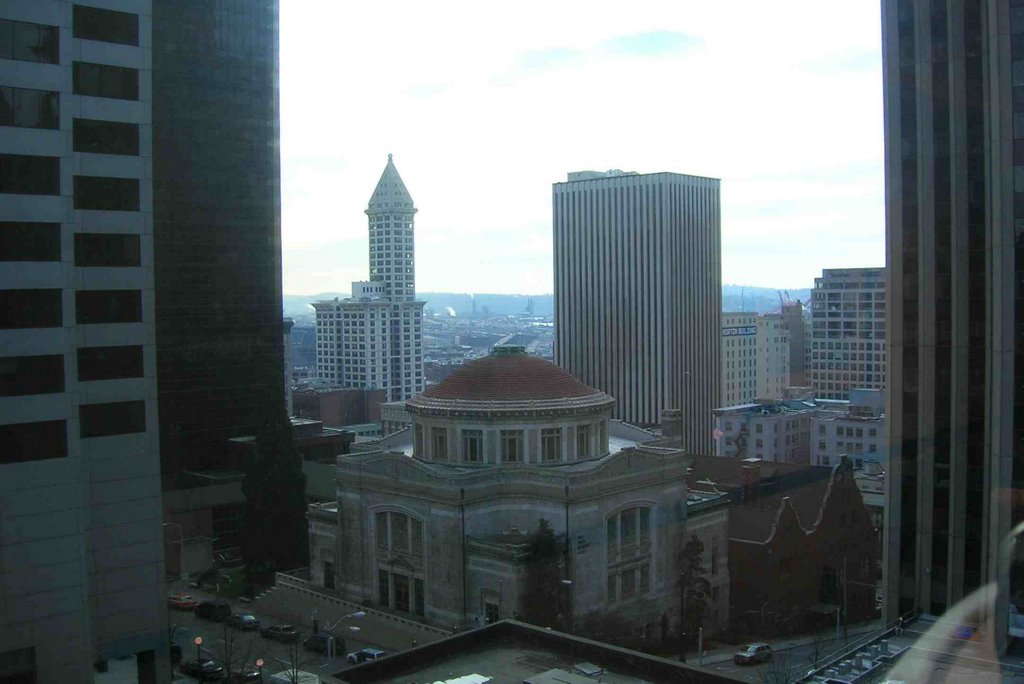
Seattle as viewed from my hotel...

Friday, February 02, 2007

US TOUR 2007, DAY SEVENTEEN:

Across a shimmer of black water, the lights of Seattle pricked a night sky turned to mother of pearl by a full moon.

We were cruising in the dark along the far shore of the suburb of Magnolia, myself and three nice people from California and Indiana. We were in a taxi following convoluted instructions to the home of the Karps, a delightful and eccentric couple who were hosting a party for my publisher, Poisoned Pen Press. Larry Karp is another of their authors, writer of the well-received "The Ragtime Kid".

Life tips you sometimes into some strange places. The home of the Karps is one of them. I should have known when I saw their name painted on the side of the house - The Karps - a painting of a carp beneath it.

Then it was like walking into a museum. A fantasy time-warp of antiques - every available shelf and laying space taken up by literally thousands of collectibles: toys, hedgehogs, wedgewood china, music boxes - large and small. My immediate response was, my God, how do they dust all these? Someone from Arizona, read my mind and said, 'Good job they don't live in the desert. Dust accumulates in drifts by the day.'

Posters and paintings stared at me from out of a distant past.

Windows looked out across the water, unparallelled views towards the city, and the snow-capped mountains beyond.

Two hundred year-old music boxes, engineered with extraordinary precision, rang out across a room cluttered with historical artefacts. I chatted to my publisher, Barbara Peters, and the author with whom I will be appearing jointly at the Poisoned Pen Bookstore in Scottsdale, Arizona, in three weeks, Mary Anna Evans, writer of the Faye Longchamp archaeological mysteries.

This was all just a little unreal. The temperature had fallen nearly thirty degrees (fahrenheit) since I waved goodbye to La Patronne in Southern California earlier that morning - like flying back into winter. But at least the sun had been shining, a dazzle of snow on the mountains, the Pacific northwest a hard steel blue.

From the Renaissance Hotel, perched atop the highest hill in the city, I had made my way down to the Pike Street fish market to banish hunger in a tiny eatery that serves the best clam chowder in the world. A large helping of smoked salmon chowder with sourdough bread did the trick. Then a coffee. I retraced my steps and stopped at one of the half dozen Starbucks I had passed en route. This was, after all, the home of the famous coffee shop chain.

I was struck again, by the similarity of this city, to my home town of Glasgow, and thought of the meeting I had set up for Saturday morning with a friend I hadn't seen in twenty years.


Bill Hill and I were journalists together in Glasgow in the seventies, and we wrote and played music together. But then I went into television. He went into software development. We lost touch. Years later I found out he had been headhunted by Microsoft and now heads up one of their major software research divisions.

Like myself, he is a man who likes to wear the kilt.

Which brings me back to Magnolia, and the PPP reception at the Karp's. In conversation with my hostess, Myra, she mentioned that every time they went to the opera in Seattle they were struck by the sight of a man who always wore the kilt.

'Does he have a big beard?' I asked.

She seemed surprised. 'Yes, he does.'

And does he have dark hair pulled back in a pony tail?

Her eyebrows shot up. 'Well, yes.'

'Then I think, perhaps, you are talking about my old pal, Bill Hill.'

'What an extraordinarily small world,' she said.

I'll find out on Saturday.

Sunday, January 28, 2007

US TOUR 2007, DAY TWELVE:

It was an act of sheer insanity! My last free Saturday spent cooped up in a car on an eight-hour round trip into the rural heartland of Central California. In my kilt!

I have to ask... what in God's name were we thinking about? Well, I'll tell you. We were thinking about our roots, and our culture, and a man who expressed it all better than anyone else before or since - the Scottish national bard, Robert Burns.

Yes, we travelled three hundred miles through torrential rain to attend a Burns Supper!

How crazy is that?

Well, it was the strangest experience. The only time in America that I didn't feel conspicuous in a kilt. It was magic. One hundred and eighty people with claims to Scottish origin - some with such typically Scottish names as Gutierrez and Pazeian - turned out to pay their respects to the bard, to eat haggis, and have a good time.

There were kilts of all shapes and sizes - draped on men all shapes and sizes. There was a pipe band who marched and puffed and blew, exertion turning cheeks that typically Scottish skin hue of pink-verging-on puce. There were lassies who danced the Highland Fling around crossed swords on the floor. There was the piping in of the haggis, followed by a lively rendition of Burns's ode to that "chieftan o' the puddin' race", and the stabbing of the beast to release its "reeking" vapours.

It was very emotional, almost like being at home - until it was announced to the assembled that there were three REAL Scots in the room (moi, la Patronne and le Beau Frere) who had driven all the way from up Newport Beach. And we had to stand up - to thunderous applause - our faces turning rouge. And those happy Californians knew for certain that their ancestors truly were insane.

What would be even more true to say was that we received the warmest of all possible welcomes from the absolutely delightful folk of the Scottish Society of Central California in this cowboy town called Fresno http://www.scottishsociety.org.

We ate prime rib, and mashed tatties, and neeps, and, of course, haggis - the best any of us had had since leaving Scotland. We listened to speaker after speaker. And then, the highlight of the night. Ed Miller. A Scotsman from Edinburgh, now living in Austin, Texas, who accompanied himself on guitar to sing the songs of home http://www.songsofscotland.com. Not just songs written by Burns, but a whole spectrum of Scottish folk songs that brought long-forgotten words back to mind, and tears to the eye. There's nothing more maudlin' than a Scot a long way from home - "I'm no' awa' tae bide awa', I'll aye come back tae see ye."


He was, too, very funny, with that characteristic self-mocking Scottish wit, and a Burnsian belief in the common man. He told the story of the ceremony where he took American citizenship. There were, he said, only a handful of Europeans. By far the majority were Mexican. However, the three people chosen to say something were all English speakers, which he felt was not a true reflection of those who were there. He chose not to speak, but to sing. "A man's a man for a' that" - one of those seminal Burns songs that made him so popular amongst 20th century socialists. And to correct the imbalance, he sang the last verse in Spanish.

The spell was broken as we left the hall and ran through a downpour to find our dripping vehicle in the parking lot. When began the long drive back through the night, clouds bursting all around us, roads turning to rivers, and visibility reduced to a few metres...

...arriving back at Newport Beach at 2am to find that not a drop of rain had fallen.

And with the moon rising in a clear and starry sky, reflected in the still expanse of the Pacific Ocean, we had to wonder if somehow we had just stumbled back out of the mists of Brigadoon.

Friday, January 26, 2007

US TOUR 2007, DAY ELEVEN:

Postscript to yesterday's blog...

GOOD JOB, STANLEY!

TOUR 2007, DAY TEN:

After the abscessed tooth and the burst water main, the final, disastrous indignity!

About three weeks ago, I had a root canal done on one of my front teeth, after which my French dentist told me that the tooth was very fragile, and that I should take great care when biting into stuff.

Well, I did.

But the damn thing went and broke on me anyway - last night, at the end of a great meal. And I don't even recall biting down on anything. But suddenly there it was, rattling about in my mouth - my front tooth.

And there am I, with twenty public speaking engagements over the next six weeks, looking like someone who escaped from a Dickens novel. A great testament to French and Scottish dentistry - or maybe just my crumbly teeth!

Oh, shit!

Well, Susie got me an appointment today with Stanley - he and I are getting to know one another too well. So, we'll see what the dashing dentist of Newport Beach can do to restore my good looks.

Okay, I can hear you say it already. What good looks?

Judging by the picture below, he's got a helluva job on his hands!

Thursday, January 25, 2007

US TOUR 2007, DAY NINE:

We were supposed to be out on the ocean watching for the spouts of whales as they headed south from Alaska. Instead, workmen from across the road came rapping on Susie's door to say there was water bubbling out of the ground at the front wall of her house.


We went out to look. Right enough, water was forcing itself up through the flowerbed and gushing chocolate brown across the pavement and along the gutter. A leak in the water main. Susie rushed off to phone the City, whose responsibility it would be to fix it.

I stood in the street watching. And right before my eyes, the ground began to tremble. The earth heaved and puffed and blew. A shrub got pulled up by the roots, before suddenly a powerful jet of water simply exploded out of the ground.

Thar she blows!

It was not the kind of spout we had been anticipating. But the force of it was incredible, exiting the ground at an angle, slamming against the wall of the house, ripping at the gutter, before deflecting twenty feet above the roof, a rainbow forming in sunshine through fine spray.

By now, everyone was out in the street. Neighbours, workmen, passers-by. It was an extraordinary spectacle, and a huge hole had formed in the ground. It took the waterworkers from the City more than half-an-hour to get there. All the while we were praying that the gutter would hold. Because if it gave way, the force of the water would rip up the roof and the damage would be unthinkable.

When finally the City workers arrived they gawped open-mouthed, and then spent the next half-hour trying to find the valve to turn off the water. They were up the street, down the street, round the corner, before finally finding the right one, buried under crap in a building site next door.

We left them to it, and belatedly met up with Pam and Mick who were taking us out whale-spotting on their boat. As we cruised gently out of the harbour towards the ocean, we finally began to relax after the morning's excitement.

Sadly, Susie's geyser was the only one we saw that morning. No whales to be seen. We did, however, spot an enormous elephant seal, and a handful of dolphins who played around our wake for a while, before we returned for a gentle tour of the harbour, drifting past the homes of millionaires while chomping on avocado sandwiches.

By the time we got home, the repair was finished, and the water guys had replaced all the earth that had been washed away. They had cleaned up the road and the pavement, and you'd never have known that anything untoward had happened.


The "Mushroom House", on the market for a cool 75 million dollars...

Wednesday, January 24, 2007

US TOUR 2007, DAYS THREE TO EIGHT:

What was supposed to be a short respite before the onslaught of the tour proper, has turned somewhat calamitous.

It started, I suppose, the night before we left. A dull ache in a back tooth. It responded painfully to pressure. No time to go to the dentist. A train to catch, then a plane. I thought maybe it was caused by the stress of travelling and might recede.

It didn't.

Gradually, day by day, it got worse, until by the weekend I could barely eat, the pain was so bad. Susie phoned her dentist and he called in a prescription of antibiotic to the local pharmacy. Three days of taking the pills and the pain had started to wane. But I went this morning to see the dentist in person, and an x-ray confirmed worst fears - an abscess. So I spent the next hour in the chair of a charming man - Stanley Armbruster, who had treated me once before, eight years ago - and submitted myself to a serious piece of root canal treatment.

What fun! Not.

The only consolation as I sit here clutching my sore jaw is the sunshine spilling through large windows, and sunlight coruscating across the stainless steel waters of the Pacific. Pain in paradise.

On a lighter note, we went yesterday morning to buy a beach bike as a gift for our host, Susie, so she could accompany us on our ten mile jaunts along the boardwalk to Huntington Beach. We picked out a perfect Newport Beach bike - pink and green, with white trim and a white saddle. She says she's going to have to buy a new outfit to match it.

The guy who sold us the bike was patenting a new way of riding these self-balancing segway machines that turn ordinary mortals into impossible pedestrians on wheels. I'd seen a few folk riding around on them and always wondered how they never fell over. Well, he insisted I find out.

With great trepidation, I climbed on to the footboard of the thing and he strapped my knees to a central pole. It was completely hands-free. Nothing to hold on to. "Normally, it takes me fifteen minutes to train someone on one of these," he said. 'But with this model you just mount and ride." Well, I'd mounted, but I wasn't riding yet. I was waving my hands around like a demented tightrope walker. He sighed patiently. 'Put your arms down."

I did as I was told.

"You lean forward to go forward, lean back to stop. Use your knees to turn left or right."

I managed to turn straight into a wall.

"Have you never been ski-ing?" he asked.

"Nope"

"Snow-boarding? Surfing?"

"Nope.

As I found myself going round in a circle on the same spot I heard the exasperation in his voice. He turned to La Patronne. "He's the only person I've ever come across who has no control of his knees." He looked at me as I swivelled my torso left and right to no effect. "Man, I'd hate to see you on a dance floor."

As the laughter of the watching hordes - La Patronne and Le Beau Frere - subsided, he unstrapped me and showed me how it should be done - whizzing backwards and forwards along the pavement with the greatest of ease. It looked great fun. But somehow I didn't think I would ever master it. Brain-hand coordination doesn't extend beyond the computer keyboard in my case.

Having finally controlled the urge to burst out laughing every five seconds at the memory of my hopeless gyrations, La Patronne confessed, "We might be laughing, but really it's just in relief that we didn't have to do it."

We'll see about that!!

Tomorrow it's off whale-spotting.

The Newport Beach Bike...


Sunset over Catalina...

Friday, January 19, 2007

US TOUR 2007, DAY TWO:

"Excusez-moi, madame!"

I had my back turned to him, so I suppose all he saw was the skirt and the pony tail. But his face, when I turned around, was a picture - of shock and embarrassment. "Madame" turned out to be six feet, two, with a prickly silver beard. For a moment, I guess, he thought I was going to hit him. But when La Patronne burst out laughing and I grinned, his fear gave way to embarrassment.

I had been about to enter one of these airport queueing mazes at the wrong end as we headed towards the security check, and the security guard had made an unfortunate error in identifying my sex.

When I take my kilt with me on transcontinental promotional trips, I never risk leaving it to the vagaries of the baggage handlers. It would, after all, cost nearly a thousand euros to replace. All eight metres of heavy tartan wool. So I wear it for travelling.

It always attracts attention, whether in France or the States. Sometimes, as at the airport, it is the wrong kind. I always get searched. Take off the boots, take off the sporran, take off the belt. And, in this case, twice. Once at security, and once again before being allowed to board the bus that would take us to the plane.

I'm sure I only get asked to take off my boots so that when I crouch to lace them up again, security officers of both sexes are hoping to get a glimpse of what I'm wearing underneath the kilt.

Sometimes the attention it attracts is a little more welcome, as on the plane itself when I was accosted not once, but twice, by pouting stewardesses anxious to talk to the man in the skirt. As I stood mid-aisle exercising to avoid a long haul embolism, a tall, elegant ebony-skinned stewardess approached and leaned close. "Are you Scottish?" she whispered. "Oui," I told her. She giggled. 'Oh, I like it,' she said, and flushed, and hurried quickly away.

La Patronne returned from another adventure at the toilet, to tell me she had overheard two stewardesses excitedly discussing the man in the skirt - "didn't you see him coming on the plane?" - blithely unaware that the woman beside them was his wife.

Then later, when the cabin steward leaned over to tell me that "you are my first Scottish", his colleague - a striking looking stewardess with brilliant red lip gloss - dipped her eyes coyly in my direction and said, "I find eet ve-ery sexee.'

Which was when La Patronne drew the line. "Don't tell him that!" she snapped - the rest left unsaid, but not misunderstood. She's a real spoilsport!

Many hours later, tired and crushed by the coach class experience, we arrived in LA to be met by a seriously unwell Susie, with whom we would be staying at Newport Beach for the next two weeks. Ravaged by a virulent cold virus (what else would a virus be but virulent?) that had reduced her voice to a sound like torn paper, we headed south for a quick meal at her home overlooking Balboa Island, before putting her to bed with a hot toddy. Then falling, ourselves, into bed, to sleep away the effects of the journey, glad to be in southern California, in the sunshine, for a brief oasis of calm before the storm of the tour.

Day dawns over Balboa Island...

Thursday, January 18, 2007

US TOUR 2007, DAY ONE:

On the road again!

It hardly seems credible that nearly eighteen months have passed since I was sitting in an Ibis Hotel at Roissy Charles de Gaulle airport in Paris writing the first blog of my September 2005 tour of the US to promote "The Firemaker".

Well, here I am again. This time to promote the second tome of the China Thrillers series, "The Fourth Sacrifice", which comes out in two weeks, and the first of my new series set in France, "Extraordinary People", which came out in November to a chorus of fabulous reviews.

All this on top of having just signed a movie option for "The Firemaker", and writing the screenplay treatment jointly with La Patronne - not to mention the terrific sales of the first three China books in French translation, and months of touring bookfairs and bookstores throughout France.

All the more incredible, since just twelve months ago I was sitting without a single English-language publication deal wondering how I was going to pay the bills in 2006. Such is the precarious and uncertain life of the writer.

Ah, well, at least I start off the tour in the company of La Patronne this time. Life with the formidable lady is never dull, especially when travelling. We were barely on the train when she had her first adventure in the toilets. She either gets locked in, locked out, or flooded. This time she had locked herself in, with a mad woman hammering on the door. Apparently the woman had arrived at the toilet before La Patronne, but was unable to open the door - even although it was vacant. She went off to get help. La Patronne arrived and applied a shoulder with her usual delicacy, unceremoniously bursting into the empty cabine. She locked the door and sat down to do what had to be done. At which point the lady who had been unable to open the door returned with a burly gentlemen, who then proceeded to try to force it open. Much to La Patronne's distress.

Finally he gave up and went away, and when La Patronne emerged in a flush of relief, it was to find an elderly French lady glaring at her, no doubt wondering why she had occupied the toilet for so long. Needless to say, La Patronne felt no explanation was necessary, and hurried off to interrupt Cabrel on my iPod with her tales of woe. The moment I saw her red face approaching down the carriage, I knew that there was one. There is never any alternative but to listen and sympathise.

For most of the journey, however, my thoughts were occupied with the third book in the French series. My publisher, Poisoned Pen Press, has dubbed the series "The Enzo Files" - after my cold case-cracking main character, Enzo Macleod. I have just finished the second in the series, working title "The Critic". It is set amongst the vineyards of Gaillac, and I think I have finally sobered up after an intensive period of research. So I was turning my thoughts to the next one - thoughts which are already pretty far advanced. Endless travelling hours provide good down time for letting the mind work around story and plot, and I'm excited enough now to think I might even start it in April after I get back from the States.

Better go now. La Patronne is lying on the bed with her legs in the air, trying to realign her spine after the train journey. I think I might have to thump a few vertibrae back into place.

We fly out first thing tomorrow (Wednesday, January 17th), but I probably won't get the chance to post this until we get to LA (Wi-fi access here is 10 euros for two hours, and I'm too much of a Scot to pay it). By the time I do, there will no doubt be more adventures in toilets to report!

La Patronne demonstrates her cure for a bad back...

Saturday, June 24, 2006

PRIZELESS PROSE
It is not often that an author has a book nominated for two prestigious awards at the same time - and then has to decline both before the winner is even announced.

That's what happened to me this month.

A month which began with my appearance, in Paris, at the annual announcement by Elle magazine of the winner of its Grand Prix - a literary prize awarded by eight juries of the magazine's famously discriminating readers. I was there because the first of my China series, "The Firemaker", had been shortlisted for the prize in its French incarnation of "Meurtes à Pékin". It didn't win, but just to have been nominated was a tremendous honour.

A month which saw me zig-zagging across France from book festival to book festival; attending the Paris launch of "L'éventreur de Pékin" ("Chinese Whispers) by the biggest French bookclub, France Loisirs; speaking on panels; performing radio interviews; reading from my book to the accompaniment of a tenor sax; and signing hundreds of copies of "Le Quatrième Sacrifice", the second in the series. All, of course, in French - which I have been studying hard to try to improve.

A month which approaches its conclusion at the end of a gruelling week-long writing course - one of two which La Patronne and I hold every year at the Hotel Victor Hugo in St. Céré, near where we live. It went quickly and well, due in large part to the fine bunch of students who descended on us from all parts of the world for this first of the two courses.

The thousands of kilometers travelled in blistering heat did, however, have some compensations. Like sharing a stand at the Frontignan Polar Noir book festival on the Mediterranean with such luminaries of the crime-writing genre as Elmore Leonard and Larry Beinhart - a couple of seriously nice people. Or sneaking away from signing duties to share a beer or three in a gloomy bar with English crime-writers Graham Hurley, Maxim Jakubowski and Mark Billingham - all of us glued to a giant TV screen as the English soccer side stumbled its way to an early victory at the World Cup in Germany.

There are not, unfortunately, many compensations for striking yourself off the list of nominees for two of the best-known prizes given in the United States to books in the mystery genre - the Barry Awards and the Macavity Awards. But, sadly, that is what I had to do.

"The Firemaker" was nominated for both awards in the category of Best First Novel published in the US in 2005. It WAS the first book I had written since quitting television in the nineties, and it WAS the first book published in the States in fifteen years. But I had previously written four other books, and two of them had been published in America. So my initial euphoria at being nominated for both a Barry and a Macavity was very quick snuffed out. There was no getting away from it. I didn't qualify, and I had to fess up. And so I e-mailed the award organisers to (very reluctantly) rule myself out.

If there were any compensations, they came in the form of the righteous, if regretful, satisfaction I took from knowing I had done the right thing. Then there were the kind words of Macavity organiser, Janet Rudolph, who apologised for the mix-up and consoled me with the comment, "great book, though". And my agent in London, who said, "Still, everyone thinks it's a bloody good book."

Ah, well, onwards and upwards. The proofs of my new book, "Extraordinary People", arrived this week. Published by Poisoned Pen Press, it will be released in the US and the UK at the end of November. Advance reading copies (ARCs) have already provoked enthusiastic responses. "Wonderful," was how one bookseller described it. "I found it hard to put down," said another. Let's hope everyone else feels the same way.

And it would be nice if it were to win future nominations - perhaps in the category of Best Eleventh Novel!

Onstage during a televised debate at Saint-Malo, France

Sunday, April 09, 2006

I'm taking a quiet moment to reflect on a turbulent few months. The first of my China Thrillers, published in France as "Meurtres à Pékin", has really taken off.

Selected by the readers of the French magazine "Elle" for their annual Grand Prix, it is this month's (April) Crime Book of the Month. Seven other titles are in the running for the Grand Prix, and the winner will be announced in May. I don't really expect to win it, but just to be selected is a huge honour. It has meant that the book is getting front-of-house promotion in Virgin Megastores throughout France - which can't hurt sales.

I am now receiving invitations from all over the country to appear at Book Fairs and Festivals. One weekend I'm at St. Malo on the English Channel, the next weekend I'm at Frontignan on the Mediterranean. I have a meeting with my readers at FNAC in Toulouse, a jazz dinner organised by a bookstore in Figeac, a signing in Marseilles... I wonder when I'm going to find the time to write.

The Salon du Livres in Paris - the biggest book fair in the country - took place in the middle of March. I was signing on my publisher's stand for two days, and also made a public appearance as part of a forum of four writers being questioned by a journalist - ALL IN FRENCH!!

The second in the China Series has also just been published here - "Le Quatrième Sacrifice" - and at the beginning of June the sixth in the series, "L'Eventreur de Pékin" will be published by the biggest book club in France, France Loisirs. They have four million subscribers! I met two of their editors in Paris - attractive young ladies who wined and dined me in a classy restaurant near the Eiffel Tower. Life could be worse!!

During a month spent in California, in February, my New York publisher St. Martin's Press confirmed that they will take books two and three in the China Series. "The Fourth Sacrifice" will come out in the States on January 7th, 2007, with "The Killing Room" following shortly after.

During my California sojourn another US publisher - Poisoned Pen Press - snapped up the first book in a new series, set here in France. Working with editor/publisher Barbara Peters has been an absolute joy. The first book, "Extraordinary People" will be published in the US and the UK in November, 2006. I have been commissioned to write the second book in the series, and have just returned from a research trip to the undiscovered wine region of Gaillac - about two hours south of where I live.

Having to research wine for a crime thriller is one of life's great bonuses. I hope to have sobered up by next week.

By way of a footnote: when I returned from Gaillac, it was to find an e-mail from my pal, artist Gilbert Raffin, enclosing photographs he took of "Le Quatrième Sacrifice" in the window of one of the most influential bookstores in Paris. By coincidence, right next to it, was a book by a Chinese crime writer called Qiu Xiaolong, whom I met at Bouchercon in Chicago last September.

A double coincidence, really, since Gilbert sent me a photograph of the same window a few months ago, when "Meurtres à Pekin" was prominently displayed - right beside a book written by my old friend, the Chinese crime writer He Jiahong, who lives in Beijing.

It seems I can't help bumping into old friends in shop windows!

Sunday, November 20, 2005

Returning this morning from three days of tasting wines in Gaillac, I found an e-mail awaiting me from my incomparable translator, Ariane. She and Gilbert (who designed the French book cover), were in one of the biggest bookstores in Paris yesterday - chez Gibert in the Boulevard Saint-Michel. On the table, on the first floor, prominently displayed amongst the bestselling books, they discovered a pile of copies of "Meurtres à Pékin" snuggling up to some anonymous book called "The Da Vinci Code" by someone called Dan Brown. Who he?

Chez Gibert, Paris

Sunday, November 06, 2005

All over. A hundred books sold - or thereabouts. Endless hours of standing smiling at people, engaging them in (French) conversation, hand-selling my books. This is the sharp end of writing that most authors never get to experience. This is hard-selling direct to the public.

This is seeing their noses wrinkle when they read the blurb on the back of the book, or even when they catch a glimpse of the title. There are, clearly, some people for whom "Meurtres à Pékin" is inestimably distasteful.

With graphic descriptions of carbonised corpses on the back cover, I wonder what on earth could have put them off? Ah, well, chaque à son gout.

One simply has to expect that what one writes is not everyone's cup of tea.

To balance that, my publisher, Danielle Dastugue, was delighted with our sales. For an "inconnue" - unknown - in France, it would have been perfectly possible to sell two books or less, she said. We had done well.

The day started off with a change of stands. We were moved to another stand in the foire, judged to be in a better position. The two young girls, and rugby playing student, who had taken the money and popped the books in bags for us all day Saturday, were almost tearful to see us go. Not unhappy, however, to see the back of us, were the man-hater and Mr. Cèpes, who had deigned to turn up for the Sunday session. Our departure meant they got a bigger and better display.

We, however, found ourselves crammed into a breathless space between a purveyor of philosophy and a writer of such titles as "Le Pinkie-Pinkie", whose cover was adorned with the screaming face of a tortured man. Opposite was an emergency exit which, while providing an outlet for people in trouble, also provided an inlet for frequent blasts of icy autumn air. I was glad I had brought my jacket.

What was nice was that both the young girls at our new stand bought and asked me to sign copies of the book, and that the girls from the previous day's stand paid us several visits to check that we were okay. One of them said she had started to read the book the night before and couldn't wait to get back to it. She reads "polars" (crime books) all the time, she said, but somehow this one was different, and she was really intrigued.

We made a point of going and saying goodbye to them all when we left.

Ariane and Gilbert appeared late morning, and we tried to make an arrangement for lunch, but the restaurant where we were scheduled to lunch, courtesy of the municipality was only scheduled to take six from Editions du Rouergues. Our poor friends wandered off disconsolately to try to find somewhere to eat, and we went in search of Michèle to see if we could find a solution to the problem. No problem, she said, call Ariane and tell her there are places for them at the restaurant - Chez Francis, in Avenue de Paris, reckoned to be the best in town.

By coincidence, the hapless pair had just tried to get into that very restaurant, which had been recommended by a friend, and had been turned away. Complet! At which point my call came through on Ariane's mobile.

So we all met up for lunch, only to discover that Danielle and Michèle had been unable to get two extra places, and so had sacrificed theirs to partake of salads in an inferior joint across the street. No amount of argument would dissuade them from this.

Publishers are different in this country!

Another nice moment came that afternoon when a gentleman we had spoken to earlier in the day about cultural and linguistic exchanges, returned to reveal that he worked for Les Trois Epis, the bookseller, and that his boss had told him that he could chose any book at the foire, have it signed, and he would pay for it. He chose "Meurtres à Pékin", which I took as a real compliment - considering the hundreds of thousands of books available at the fair.

At the end of the day, we said fond farewells to Danielle and Michèle, and Daniel and Roger and Adeline Yzac (another Rouergue writer whom we had met that morning), and disappeared off into the cold, dark night, to make our way back to a cold, dark house and try to get it warm before collapsing into our own bed for the first time in what seemed like weeks.

And it was only three days.
An eleven hour day! There should be a union to protect writers from this. Trouble is, if we don't do it no-one else will.

This was Saturday at the Foire du Livre in Brive la Gaillarde, all day at a stand hosted by Les Trois Epis bookstore. I had a display of books and a chair and was required to be on duty all day to greet potential customers and sign the books that they bought.

We weren't in a good spot, though. Near the entrance. Everyone arriving hurried by to see the fair, not wanting to stop and look at the first display. On the way out, they'd done their buying and weren't interested in looking at anything else.

Besides which, I was sandwiched between "The Book of Cèpes", whose author never dared once to show his face (after all, how could you write a whole book about cèpes?), and "My Life with a Brute" (or words to that effect) - a comical description by a divorced women of her life of hell with men, and what changes she would like to make to them.

I saw her eyeing up my kilt a few times and felt a touch uneasy, and then got ticked off when a gaggle of teenage girls (most of whom appeared to be her children), and their spotty boyfriends, stood in front of my book display and chatted to her for hours on end.

The greatest indignity, though, was that more people seemed intersted in the cèpes than "Meurtres à Pékin". They were drawn to it like flies to the dung, although I think there were only two copies sold all day. The man hater didn't sell much either. So I suppose I had the last laugh (although laughing was the last thing I felt like doing), when I managed to sell twenty-five books. It doesn't seem like much over a long day. Five hundred euros worth of business, all the same. And when added to the sales of launch night, probably totalled around 75 books, or fifteen hundred euros.

Which doesn't make much of a dent in the six thousand copies that Editions du Rouergue have printed - about four times as many as Hodder and Stoughton produced in hardback. They clearly have faith in the book. I hope they're right.

The only bright spot in the day was lunch at the chic new restaurant Les Arums, again paid for by the municipality. This was a bright, airy, modern restaurant, with a huge salle through the back, and tall windows opening on to a luxuriantly green garden, and a young patronne who had poured herself into leather trousers that seemed somehow to have moulded themselves to her every curve. It was quite hynpnotic when she walked by our table.

We were joined - Danielle, Michèle, Daniel, La Patronne and I - by a famous French writer and broadcaster called Philippe Meyer. He was a big man with a shock of salt and pepper hair, a lovely manner and a nice sense of humour. Lunch passed in a haze of good food and wine, laughter and tight leather trousers.

All of our food and wine, it seems, over the whole weekend, is to be provided by the town. I'm not complaining.

Sales were slow in the afternoon. The place was jam packed, and La Patronne, who had sat faithfully by my side through most of the morning, was overcome by a post prandial torpor, and slipped off to take forty winks in the car, in the dark anonymity of the underground carpark beneath us. A flurry of sales in her absence, rescued me from a slow start. I heard that the queue to get in stretched all the way up the Rue de Paris, and that people were having to stand in line for more than an hour and a half.

What amazes me is that they did! What an appetite people here seem to have for books and writers.

At the end of the day - it was almost 8pm - we all traipsed off to the Boulevard Restaurant again for more good food and wine, before driving back to our hotel through dipping temperatures and thick fog.

Winter, it seems, has finally stamped on the tail end of summer.

And tomorrow we do it all over again.

Between a Cèpe and a Hard Place

Saturday, November 05, 2005

Guy Fawkes night. Bonfire night. The day when everything goes up in flames and fireworks light up the sky.

Well, it wasn't quite like that last night in Brive, but it was "pas mal" all the same. There was a fabulous turnout for the booklaunch at Les Trois Epis. Sixty or more people turned up, including some old friends I hadn't seen for years.

The neighbours from my village turned out in force to support me, for which I am eternally grateful. They are good people. Even those who couldn't come asked neighbours to get them copies of the book. We sold fifty or sixty books, and the owners of the bookstore were more than delighted - a thousand euros-worth of business in an hour and a half. The publisher, too, was pleased, because it established a good relationship between themselves and a store with which they had never had a relationship. Ground was broken - in a good way.

I suppose I could have got away with not making a speech at all, or even a very truncated version of it. But having put in all the work on it this week I was damned well going to make it anyway. And boy was I nervous!

I am so used now to making book presentations in English that I am accompanied only by the odd butterfly. Last night they just about suffocated me. It is a long time since I felt that scared. My mouth got so dry towards the end that I could hardly get the words out. I dried halfway through, when my mind just went blank, and I had to call on my souffleur - Ariane - for a prompt. What seemed like an eternity to me thankfully only lasted a few seconds. Ariane gave me a line to get back into the speech, and off I went again like a demented automaton, stumbling to the end and managing, hopefully, to tell my story in the process.

All in all, it could have been worse.

The great surprise of the night was the appearance of my former neighbour from Carennac, Georges Monteiro, and his "bidey in", Brigitte, along with their young son, Antoinin, who was no more than a baby when last we saw him. It was a joy to seem them again. Georges really is the salt of the earth. We had never before done anything other than shake hands. But last night we embraced, and he made us promise to come and eat at their new home near Puybrun. I look forward to it.

Afterwards we poured out into the cool of a damp Brive evening, Danielle Dastugue, my publisher, her commercial organiser, Michèle, another Rouergue author, Daniel Crozes, and Ariane and Gilbert. We all headed off to a restaurant called "Le Boulevard", just off the Place Winston Churchill. Lights shone out through large windows on to a leaf-strewn garden which we had to cross to reach it.

The Mayor of Brive extends an invitation to publishers and writers to dine at the town's expense at one of twenty nominated restaurants. A full menu, coffee and wine included - for the Friday night, midi on Saturday, Saturday night and midi on Sunday. It's an extraordinary gesture by the municipality. No wonder the publishers and writers descend en masse from Paris.

(An interesting aside is that the underground parking beneath the market square is free for the duration of the Foire. If this were happening in the UK or the US, somehow I think the parking charges would have increased for the weekend!)

During the meal we discovered that Daniel is the longest serving writer on the books of Editions du Rouergue. He was the first writer to be published by them when they were a fledgling company run single-handedly by Danielle Dastugue, and he has written twenty-six books in the last twenty years. What a prolific output! I have to take my hat off to him. And what a nice man, too. He and I are sharing the signing sessions at the publisher's stand throughout the weekend - their oldest and their newest writers.

We also discovered that the second book in the China thrillers series, "The Fourth Sacrifice", has had its publication date brought forward so that it will be launched at the bookfair in Paris in March. This is a major honour. It was also news to Ariane, who has only just begun the translation of it.

Gawn yersel' wee yin!

The night ended with a hairy drive through the wet and the dark to our hotel in the tiny village of St. Viance, ten kilometres north of Brive. Everyone from Rouergue is staying here, but La Patronne and I were the only ones who knew the way - since we had checked in earlier in the afternoon. So everyone else followed us. Which would have been fine if La Patronne hadn't suddenly said to me as we sat at traffic lights in the town: "The lights have turned green!" I looked up and saw green. But it was the green of the next set of lights, and we promptly drove right through a set of red, leaving my publisher et al trailing in our distant wake.

However, they finally caught up, and we found our way safely to the Auberge sur Vézère, where La Patronne and I fell back in our room to work our way into a fine bottle of Glenmorangie that we had planked earlier.

Today it all begins again. I wonder if I'll still be able to speak English by the end of the weekend. Vraiment a case of death by French!

With Ariane

Friday, November 04, 2005

Well, today's the day. The French launch of "The Firemaker" under the title of "Meurtres à Pékin".

It is being held tonight at Les Trois Epis - the biggest bookstore in Brive - on the eve of the biggest bookfair in France outside of Paris, La Foire du Livre. Last year it was visited by 120,000 people over the course of the weekend, which really begins tonight when the "Book Train" arrives from Paris carrying the publishers and journalists, and more than 500 writers, from the Capital.

Many of them are attracted not only by the bookfair, but by the fact that at this time of year the traditional fare of southwest France is readily available in all the markets and shops at better prices than in Paris. I'm talking, of course, about foie fras and the confit de canard - those high fat foodstuffs which, miraculously, don't even seem to dent the French reputation for having the lowest rate of heart disease in Europe.

Hmmmmm. Eat on.

La Patronne, of course, has done her usual excellent job of preparing the publicity for the book and the launch. She has produced a press pack, in French, which is downloadable on PDF from the new French website which she has just launched. It is viewable at: http://www.petermay.fr

It also contains a link to a downloadable podcast which I have just recorded in French. Actually, it's pretty much the speech I will be giving at the launch tonight - the speech which has obsessed me for most of my waking hours for the last week.

There were two important criteria to follow. It had to be written in a French I could speak. And it had to be something I could deliver without notes. Oh, and it had to be intelligible and interesting. Now you're beginning to understand why it has obsessed me for the last seven days.

I adapted it from one of the stories I normally tell in English when doing a book tour. I created a structure that I would remember in English, and then wrote it from within my limited pool of French vocabulary. So far, so good. But the delivery is another matter altogether - especially in front of a large crowd of native French speakers.

Ariane, my translator, and her husband, Gilbert (who designed the book cover), cast an eye over it and declared it more or less intelligible. I suggested, hopefully, that maybe I should have the speech in my hand to refer to when I deliver it. But they didn't think that would look very good, so I embarked on a course of trying to commit it to memory. Arggggh. The butterflies in my stomach were whipping up a storm already.

I spent all afternoon on Tuesday with my neighbour, Laurène, going over the speech sentence by sentence. She made some minor corrections to facilitate my delivery, and I headed off home to practise some more.

That night Ariane and Gilbert and Laurène and Roger came to dinner and insisted I stand up and deliver the speech to them. It was amazing just how stressful it was to stand up in front of a group of friends to deliver a speech in French. Somehow I managed to stumble through it, and of course, they were very encouraging.

But the proof of the foie will be in the stuffing of the duck! In other words, it'll all be down to how I do on the night. I spent Wednesday and Thursday on more practice, and recorded the adaptation of it for the podcast.

Now, on Friday morning, those butterflies have multiplied and got even more frenzied. I am just about to head off and get into my kilt - US tour revisited (one of these days I must get the damned thing dry-cleaned!). Well, if nothing else, it gets me attention - and that's what I need to sell books.

And I thought all I had to do was write them!

Tuesday, October 18, 2005

Monday morning, and La Patronne and I had a power meeting.

A week back home from the World Tour of America, fighting off the ravages of cold germs determined to take advantage of our exhaustion, shedding pounds gained by water retention and eating too much fast food, it was time to get down to serious work again.

We discussed updating our accounts, the design of the new French website, thank-you cards for everyone in the States who had been so generous with their help. We talked about the French book launch in Brive - less than three weeks away now - my promotional schedule in France, a possible strategy for the French press.

It was barely possible for me to imagine that in three hours' time I would be on a hilltop miles from anywhere pulling off the boot of a man who had nearly cut off his foot with a chainsaw.

The sequence of events which led me there began with the crunch-crunch of footsteps on the gravel in the front garden, and then the chime of the doorbell.

Standing there in a multi-coloured work jacket, and jeans and big boots, was Roger, grinning like an idiot. We shook hands. I told him to come in, but he shook his head and began speaking Quebecois French faster than a TGV. He forgets sometimes that my French splutters along about the speed of Stevenson's Rocket.

Roger comes from the Madeleine Islands off the east coast of Canada. He used to be a singer with a Quebecois band, but is now an osteopath. He and his wife, Laurène, a pshychotherapist from Paris, have bought a house in Puymule, and Roger has opened up a surgery in St. Céré.

As I fought to catch every fifth word, I gleaned that Roger had hired a lorry and was heading up to a farm in the hills near Teyssieu, where I go to get winter fuel for my wood-burning stove. Usually I go in the company of an elderly neighbour, Robert (I call him "Bob"), who has a trailer which will take two cubic metres. Bob has a heart condition, so I load and unload his wood for him, in return for which he lets me use his trailer for my wood.

So we set off in convoy. Roger and computer wizard, "Lucky", who lives in what used to be a building for drying walnuts adjacent to Roger's house, and me and Bob and his wife, Jacqui. It was too good an opportunity to miss. My stock of wood was running low from last year, and here was a chance - I thought, after hesitating briefly - to bring down a big load in a single outing. It's pretty hard work, and so my (other) work plans for the day were put on hold.

We stopped in St. Céré to pick up cash, only for Roger to discover he had left the key to his surgery at the house, and all his money and plastic were locked inside. I offered to lend him what he needed and he could repay me later, and we set off again.

Up into the hills, a winding road that climbed through autumn trees gently shedding yellow and red, until we emerged into rolling high country dotted with clusters of stone farm buildings and huddled stands of oak and chesnut.

I love it up here. The air is pure and fresh, and the land so rich and green, dipping and diving into gorgeous hollows between hills that rise out of crystal clear tumbling streams.

The farm is reached by a road that climbs steeply up one of the highest hills around. The farmhouse nestles in a cleft near the summit, and the wood is piled high to dry along a narrow track that rises almost sheer to the very top where an old stone farmhouse lies derelict.

To my eternal shame, I have to confess that I don't know the farmer's name. I have been often to fetch wood over the last three or four years, and have never once been able to decipher a word he says. Bob always phones to order the wood. He takes his meter lengths cut in half, and I take mine in thirds. Roger, who has a large, open cheminée, was happy to take uncut meter lengths. We began loading the lorry and the farmer got out his tronçonneuse (chainsaw) to begin cutting the wood for Bob and me.

He is a small man, round and jolly. He always greets us with a smile. His wife, petite and muscular, with short dark hair and a friendly grin, sometimes helps us load the rémorque. Recently she has been more pre-occupied with their young son, who has a problem with his eyes. She wasn't there today, and the old grandpa was out on the stoop with the kid. We could hear their voices rising to us on the wind, before the roar of the chainsaw drowned them out.

I didn't see what happened exactly. It was the first log. The farmer was attempting to cut it on the ground. How many times must he have done this in his life? But somehow this time the blade jumped, or slipped, and it sliced through his wellington boot and into his foot. It only takes a second. I heard him scream, and turned to see him writhing on the ground, holding his leg in the air. 'Putain! Putain!" he was yelling. The first time I've ever understood him. "Get it off!" he screamed, pulling at his boot.

Bob and I got there first and knelt down to pull off the boot. His sock was split apart. And so was his foot. A long, jagged wound had cut deep into the fleshy instep behind his big toe. Oddly there was no blood. Not at that moment. The wound, and the flesh it revealed, were strangely white. He took one look at it and rolled away screaming in pain. No doubt it was also going through his mind that his whole livelihood depended on his physical ability to get around.

We all gathered, uncertain of what to do. La Patronne should have been there. She is a trained first aider. But pure common sense dictated that we should raise his leg to stop the blood which was now starting to flow freely.

Lucky got on his mobile phone to call the emergency services. But none of us even knew the name of the farm. The farmer called it out through his pain, and Lucky relayed it across the ether. And then, in an odd moment of lucidity, the farmer gritted his teeth and stretched over to switch off the motor on his chainsaw. Suddenly all that we heard was the wind moaning up through the valleys, and then the sound of a vehicle approaching. It was the farmer's wife driving into the farmyard below, returning from the delivery of beasts to a nearby pasture. There was another young farmer with her. She came running up the hill, screaming, hysterical. "I told you to be careful! I told you!" she yelled at her husband. And then she took one look at his wound and went screaming off back down to the house. It was distressing to see such hysteria. Jacqui went down the hill after her to try to calm her, and I noticed the dogs standing at the foot of the slope staring up at their master, perplexed, knowing something was wrong, but strangely rooted to the spot.

When Jacqui and the poor man's wife returned, it was with a towel to wrap around his foot, and a pillow to place beneath his head. He was still cursing. "Putain! Putain!" His wife was still hysterical.

I felt sick, and impotent to do anything about it, and wandered back down the hill to the car, on the basis that standing around gawping would be less than helpful. I sat sideways on the front seat, with the door open, and heard the wail of a siren carried distantly on the wind. I couldn't believe how quickly the ambulance had got here. We were, after all, in the middle of nowhere, or so it seemed. It had taken us half-an-hour to drive up from St. Céré.

Then the ambulance turned into the farm road and I saw that it was from Latronquière, which must be the nearest town. I jumped out and waved them up the hill to where the injured man still lay.

I walked slowly back up to where the medics had established that the damage was not as bad as we all feared. The tendon had not been severed. Perhaps bone had stopped the blade in time. They gave him a pain killer and cleaned and dressed the wound, and carried him, half upright on a stretcher, into the ambulance.

His cheery grin had returned as he looked back out at the shocked white faces gathered all around. "You could cut the wood yourselves," he said. "I'll not be cutting any for a while." We were all appalled by the thought, and his wife put our thoughts into words. "Merde le bois!" she said. Which I took to mean the equivalent of "Fuck the wood!"

As the ambulance disappeared into the valley, we continued to load our logs in silence. All of them uncut. Bob speculated that maybe Georges, back at Puymule, would cut his wood into halves. I filled his trailer, and Roger and Lucky stacked six metres in the back of the truck. None of it would do for my stove.

I loaned Roger enough to pay for his wood, and we began the long, and winding journey back down to the town.

It was well past lunchtime when I got home, and I realised just how hungry I was. La Patronne heated my soup while I told her my story. With so much work to do, I had spent the morning heaving wood, none of which would be burned by us, and fretting over a horribly injured man. Whatever waste of my time it might have been was nothing compared to the awful events which had overtaken that poor farmer. Every time I shut my eyes I could see the jagged white of the wound and hear his cries of pain.

And I remembered Roger, on the hilltop, shaking his head and saying to me, "And you hesitated about coming at all." And it's true, I did. And I wonder, if I hadn't, would things have panned out differently? Fate is such a strange thing. It takes everything to happen in a specific order, and at a specific time, to bring about a single moment, for a single event to occur in a split second.

Maybe I should have stayed at home and done my accounts, and maybe none of it would have happened.


Roger
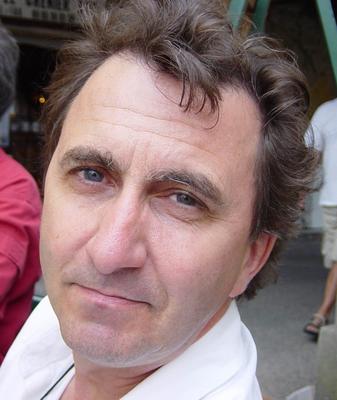

Bob and Jacqui
Sunday, October 09, 2005

Well, here we are, home again. We got back Thursday night, and this is Sunday. It feels like we've never been away - except that the bodies seem to believe we are still in some kind of daylight savings time zone in the Rocky Mountains. Can't stay awake during the day. Can't sleep at night.

T'will pass, I hope.

The journey home was quite eventful. Twenty-five hours, non-stop, from Rochester NY to Puymule, France.

It began with a laugh at airport security in Rochester. As usual they stripped me down to shirt and kilt, and asked me to step into the taped off search area, where a gentleman of dubious sexuality fumbled nervously with his wand and told me he'd forgotten how to do this.

"They showed us in training," he said. "But we don't get to do a guy in a skirt - sorry, kilt - very often."

By now, an expert in the procedure, I gave him instructions on how to proceed. One step forward.... One step back.... Careful where you put that wand!

Meantime, La Patronne was having to deal with a severe looking black guy who was staring at our boarding passes with a deep frown. He was a big, tall, muscular fella - the kind you don't argue with. But, then, La Patronne was never one to take the path of least resistance.

"What's his first name?" he said, clutching my boarding pass and nodding towards where I was dodging the wand.

"Peter," La Patronne said.

The security man's frown deepened. "It says here, MRS. Peter May." We were right back to the confusion with which the whole trip had begun. An administrative cock-up.

La Patronne took a calculated risk. After all, most security workers don't have a sense of humour. She turned and looked at me and shrugged. "Maybe it's because he's wearing a skirt," she said.

There was a long moment, when our fate hung precariously in the balance. And then the guy roared and laughed. "Man, you're BAD," he said to her. "You're BAD!" And he called to his co-security workers. "Hey, do you know what she just said?" They all gathered round, and he told them, and they all roared and laughed, too.

Watching from a distance, I thought perhaps my knees might be the object of their ribald laughter - or the fumbling of the guy with the wand.

It was only later that I discovered the truth, as we sat with two hours to wait for our plane, and the first indications reached us that not all was well. The departure board announced that our flight was delayed for fifteen minutes. Nothing much to worry about in that, we thought. We had a two hour safety margin at Newark before catching our connecting flight to Paris.

But as time wore on, that margin began shrinking at an alarming rate, and our plane got later and later. Passengers with even tighter connections than ours were getting bumped. Fog at Newark, they told us. Even when the plane finally arrived at our gate, they said air traffic wouldn't allow us to take off - because there was no guarantee we could land.

Time passed, stress mounted. Then, at the last minute, they boarded us, and the pilot said he was pleading with air traffic control to let us fly. His pleas succeeded, and fifteen minutes later we were airborn. Our two hour margin was now about forty minutes. If there were no further delays we would still make our flight.

But, then, as we approached Newark, we became aware that we were simply making circles in the sky. The captain announced we were on a holding pattern and running out of fuel. "If they don't let us land in the next ten minutes," he said, "I'm going to have to take us to Allentown, Pennsylvania."

Our hearts sank. Where the hell was Allentown, Pensylvania, and what in the name of the wee man were we going to do there, having missed our flight to Paris?

Then, suddenly, at the eleventh hour, we began our descent. We were landing at Newark after all, and embarked on a high-speed taxi chase across the apron. The captain was doing his best. But we had lost another fifteen minutes. At least the Paris flight left from the same terminal - but, of course, it was at the other end of it.

We ran through the crowded terminal, dragging heavy carry-on bags. My kilt billowed and furled in our wake. We boarded our plane with minutes to spare, but the steward told us there was no guarantee that our luggage would make the flight. We wouldn't know if it had until we reached Paris.

Fortunately we'd had the foresight to use up our airmiles to upgrade to First Class, and fell into big comfortable recliners, to have glasses of Champagne thrust in our hands, and be happily pampered for the next six hours.

And the story has a happy ending. For our luggage, after a tense wait at the carousel, finally appeared, and we were home. Intact. Absolutely exhausted, but grateful to be back in one piece.

The four hours we had to kill at the Gare d'Austerlitz passed in a trice, for Ariane and Gilbert showed up to welcome us home, and we sat and drank coffee and chatted, forced to access rusty French from tired brains. It was wonderful to be back amongst friends. We lunched in the station buffet, and A and G waved goodbye as we clambered aboard the train for our four-hour journey south.

To be met by a big, smiling Gary, in his Citroen Ami, clutching a bottle of chilled Champagne - a welcome home gift from Gary, and Roger and Laurene who had left for Paris that morning. Gary drove us back to the home I had left nearly six weeks ago. The sun was shining. The air was warm and pure, and as we sipped on the thoughtful Champagne, we reflected that, in truth, there really was no place like home.

And one final Post Script. Since arriving back, I have received an offer from a publisher for "One for Sorrow", and the Mystery Lovers Bookshop in Oakmont, Pennsylvania, reported that "The Firemaker" was at No. 2 in their hardback bestseller list.

So maybe it was all worth it. I certainly hope so.

Thanks to everyone who was so kind and generous to us during the tour, and a special thank you to La Patronne without whose organisation and meticulous planning it would never happened!


Home Sweet Home

Sunday, October 02, 2005

Ya gotta laugh! I've travelled thousands of miles - across the Atlantic, then coast to coast, right through the midwest, way down south, into the desert, up to the Pacific north-west. I've crossed swords with John Ashcroft in DC, addressed 150 guests at private launch parties, dodged hurricanes, tornadoes and thunderstorms, visited twenty cities, done Bouchercon in Chicago, and signed more than a thousand books.

And I turn up for my final gig only to be upstaged by, of all things, a baseball match!

I should have known last night, in the restaurant in Greenwich Village, when waiters were running out to the bar next door every few minutes to catch a glimpse of "the game".

Yesterday, today and tomorrow are the final three games of the season between mortal enemies, the New York Yankees and the Boston Red Sox. Today's match was critical, and being a Saturday they were playing it in the afternoon.

I should have known as we drove through the deserted streets of Boston and Cambridge to Kate's Mystery Bookshop for my four o'clock appearance, that neither the day nor the hour were auspicious.

For the first time on my tour, at my last venue, not a single soul turned up. Everyone had stayed home to watch the game. And the biggest irony? The Red Sox lost!

But I'll let you into a secret. I was really quite relieved. We had dragged ourselves out of bed at Gary and Ellen's New York apartment at six o'clock this morning. I'd had, perhaps, five hours' sleep. We drove four hours to get to Boston at the end of this long and gruelling tour, and I was - and am - frankly, exhausted. Épuisé.

So it was a relief not to have to recount my Chinese tales this one last time. And I still got to sign the books, which will still be handsold by the bookstore.

And there was a bonus. A lady who was there when I arrived, heard that I was a visiting author, spotted the kilt, and immediately bought "The Firemaker". She asked me to sign it and said, "You know, I've been happily married for twenty-three years, but I always swore that if a big Scotsman with a kilt showed up, I'd run off with him. Whatdya say?"

I told her my wife might object, and introduced her to La Patronne.

"Never mind," said the lady. She waved my book in the air. "I didn't even know about this. I work in another bookstore downtown, and I'm going to order some copies in right now."

For a moment I contemplated running off with her after all. But then I caught La Patronne's eye and thought better of it.

And baseball? Well, we used to play a street game called "Rounders" when we were kids. It's the same game. Marginally more interesting than cricket, although not much. But people here seem to love it - and to me, well, that's the real mystery!

So we headed off into the centre of old Boston to celebrate the end of the tour, only to find it full of baseball fans of both colours. Parking cost 18 dollars for two hours. Queues stood outside restaurants to eat. We finally found a table in a noisy grill house where we had pork ribs and steak tips and shouted conversations.

Tomorrow we head to Syracuse, and an overnight at the home of Le Beau Frère's son, Iain, before completing the circle by returning to Rochester for a couple of days to unwind in preparation for the journey home next Wednesday.

So, no fanfares, no marching bands, no feu d'artifice to celebrate the end of the great adventure. Just an overwhelming desire to sleep.

This is my final blog. No more tales from the World Tour of America. No more red-eye writing sessions to keep the journal up to date.

Just a big thank you to everyone who has been with me, at least in spirit, on this long and winding road. Thanks for your company and your comments. I will do one more journal at the end of next week to recount the adventures we will surely have on our return journey, La Patronne et moi.

Gilbert and Ariane phoned the other day and caught us at Ellen's apartment in New York. They plan to meet us at the Gare d'Austerlitz in Paris when we arrive there to catch our train home on the final leg of the journey. Time allowing, we will eat together at the station buffet.

We look forward to once more being with our friends, to share a simple bite to eat and a glass of wine. I just hope I still remember how to speak French.


Kate's Mystery Bookstore, Cambridge, Massachusetts


The Final, Lone, Signing

Saturday, October 01, 2005

As Le Beau Frère says, "If you're a pessimist, you'll never be disappointed."

Not that I was pessimistic about tonight's book event, but two days in New York had kind of ground me down. Claustrophobia. Tall buildings creating sunless canyons, with cold winds blowing through them to chill the bones.

And all that aggression and anger. It's not good for the psyche.

But the second last presentation of the tour, at Partners & Crime in Greenwich Village, went like a dream. Kiz, one of the partners, told me that people had been calling all week. We had a great turnout. One lady had pursued me across America, having first heard about the book at the M is for Mystery bookstore in San Mateo, California. Another, Lisa Richland, has been corresponding with me for several years. She is the librarian in Greenport, a small town at the far end of Long Island. A great fan of the China series, she bought all the books for her library, and made the trip into New York to meet me for the first time. Bobby had been chasing me all around New York, buying books as she went. At Partners & Crime, she bought another half dozen, and got me to sign them all.

Another lady, Linda Peng, was on our writing course in St. Céré at the beginning of September. Ethnic Chinese, she was raised in New York, and had a special interest in the books, as she is embarking on the writing of her Chinese family history. I wish her well.

Earlier I met with my New York literary agent, Emma Sweeney of Harold Ober Associates. I gave her a couple of manuscripts, and a pitch for "One for Sorrow". She was seriously enamoured of the idea, and is taking the manuscript home to read this weekend.

We discussed whether or not St. Martin's Press might buy the rest of the China Thrillers series. She said it was entirely down to numbers. If we sold more than two-and-a-half thousand of the hardbacks, she thought that the publisher would go for the others. She was quietly confident, since I have personally signed more than a thousand during the tour.

Afterwards, La Patronne and I had lunch with my editor at St. Martin's Press, Ruth Cavin. Ruth is the most delightful lady. She is eighty-seven years old, the doyenne of American crime editors, and still going strong. She has a sharp eye, and an unerring instinct. She, too, was optimistic about the prospects of the company buying into the rest of the series.

I told her, also, about "One for Sorrow", and she was anxious to read it. She felt that a book set in France which could be described as a "thinking man (or woman)'s thriller" would go down well in the US.

I can only hope so. I am anxious to breathe fresh life into my character, Enzo Macleod, in the second book of the series.

The one black spot of the day was Le Beau Frère's brush with the law. He turned right into Madison Avenue, when a barely visible sign forbade it. Unfortunately a police officer was there to witness it, and deduct two points from his licence. Bummer!

The bright spot was the book event itself, followed by another meal with Susie, Barbara and Mike, who insisted that since we were visitors to New York we should be their guests.

Since they are coming to spend Thanksgiving in France, at least I have the opportunity to repay their kindness.

And now to bed, for we rise early tomorrow - 6am - for the journey to Boston, and a book event in Cambridge at four o'clock. It will be my last event of the tour. I can scarcely believe it.

Like the long distance runner, I have simply put my head down and kept going. But now, daring to look up, I see the finish line ahead of me and feel my legs buckle. Must keep going. One more day.

And then it's all over.

PS: Gary and Ellen, a big thanks for the apartment. It was FANTASTIC!


Signing at Partners & Crime, New York City


Talking to Linda Peng


With Kiz of Partners & Crime